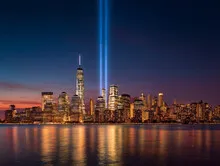
A Pilot’s Chilling Message
(Onboard a United flight to Seattle on 9/11/2001)
By D.J. Caulfield
Supplied to The New York Times
Compared to what others have endured, my experience from Tuesday, Sept. 11th was trivial. But I realize that my moment in time and the circumstances should be woven into the day's American tapestry so we might fully understand the randomness of these violent acts and how the day's events could have consumed any of us.
Tuesday morning, I was on a United Airlines Airbus on the runway at Dulles International anticipating takeoff for a non-stop flight to Seattle. It was a wonderfully clear and normal day, and I expected a smooth flight. We even pulled away from the gate right on time -- around 9:10 -- so things were looking good. I barely noticed when the pilot came on the intercom to give us what I expected would be the routine announcement of how happy he was we chose United and that we'd be X minutes from takeoff. There were actually two announcements.
The first, at 9:12 a.m., was that we may be delayed due to an incident in the New York airspace involving the World Trade Center and an aircraft that had somehow crashed into one of the structures. The pilot's voice revealed just a hint of concern. But I'm certain that many of my fellow passengers, like me, suspected that the collision involved one of the smaller planes, maybe one of those privately-owned jobs. An interesting pilot's news item, but nothing to become involved with as I prepared reading material that would help me endure a five-hour flight to the West Coast.
Then, about two minutes later, the pilot came back on. This time, the strain in his voice was clearly in evidence. He relayed what was coming over his headset: another aircraft had reportedly plowed into the remaining Trade Center tower and --- there was a hesitation almost as if he didn't know if he should share this information --- a plane from Dulles was now reported as missing. And the New York airspace was now closed.
The pilot said everything needed to be sorted out, and that may mean a flight delay of at least 15 minutes. We sat in the runway queue for about three minutes before the plane started to move. I was actually hoping to get airborne, thinking that 30,000 feet up would provide us with a degree of separation from all the crazy stuff I was hearing about.
We broke ranks and taxied slowly along an unused portion of the airport. Out the window, I could see another plane making an unusually tight turn, presumably to align itself behind us. I wondered if the incident in New York meant we'd all have to use a different Dulles runway so we wouldn't inadvertently inject ourselves into the New York airspace or otherwise interfere with whatever was going "up there."
Our plane, however, taxied along a very strange course, moving through parked planes and picking up just a hint of speed. The pilot seemed preoccupied with whatever he was doing since he didn't come back on the intercom. I thought maybe the morning's events had overwhelmed him and perhaps we'd have to change pilots, or maybe we had a minor repair to make before departure. Regardless, I wanted to be on my way to Seattle and my next assignment conducting a class on government contracting.
The plane seemed to pick up even more rolling speed and I prepared myself for a quick takeoff. But the landscape soon proved familiar and I realized we were headed back to our original departure gate. Once there, our senior flight attendant directed us to immediately leave the plane, making certain we removed all our personal belongings. "Listen carefully," she said, "Leave the aircraft, but only after taking with you all your personal belongings. Nothing can remain. You can assemble in the boarding area once you leave the plane...but do it quickly."
The authority in her voice, a marked departure from the pilot's tone, signaled to us all that this was no ordinary request, especially the part about "but do it quickly." A few fast comments among the passengers about what might cause such a turn of events ("Middle East, for sure," was the consensus) and the fleeting glances reviewing the faces of fellow ticket holders ("conspiracy" was mentioned) accompanied our movement through the plane. But we efficiently headed for the door and the relative safety of the boarding area.
There, we learned that the FAA had ordered our plane and at least two others immediately off the runway. I wondered if the combination of cross-country flight, Dulles departure and United aircraft blended to fit some hastily assembled profile. Approximately ten minutes later, we heard that the nation's entire airline system was being shut down.
Wild rumors of plane crashes in New York and around Washington, DC started circulating throughout Dulles with lightning speed. Cell phones were the communication instrument of choice and necessity. (The normal CNN airport television feed had been disconnected.) The World Trade Center towers, Interstate 95, the Pentagon, even the White House, and downtown DC were named as crash sites, and maybe more. As we now know, many turned out to be all too true.
Then came the announcement over the airport's public address system. "Get your baggage in the main terminal and leave the airport immediately." It took an hour, but I did as told and slowly made my way back home. There would be no Seattle trip today.
I can't help but think of all the good people on those ill-fated flights that, like me, simply were going through the motions of the routine. "Just get this plane up and let the day take its course." It seemed to be a normal day; it just had such terribly tragic consequences.
All those travelers and office workers in all three locations -- the two Trade Towers and the Pentagon -- will remain in my private thoughts and silent prayers forever.